The best sunscreen for boating is a broad-spectrum, water-resistant lotion or stick, SPF 40 to 50, that you like enough to apply thickly and reapply often. The brand matters less than the habit. Put it on before you step aboard, cover the spots people forget, and plan to reapply every two hours at most, sooner after a swim.
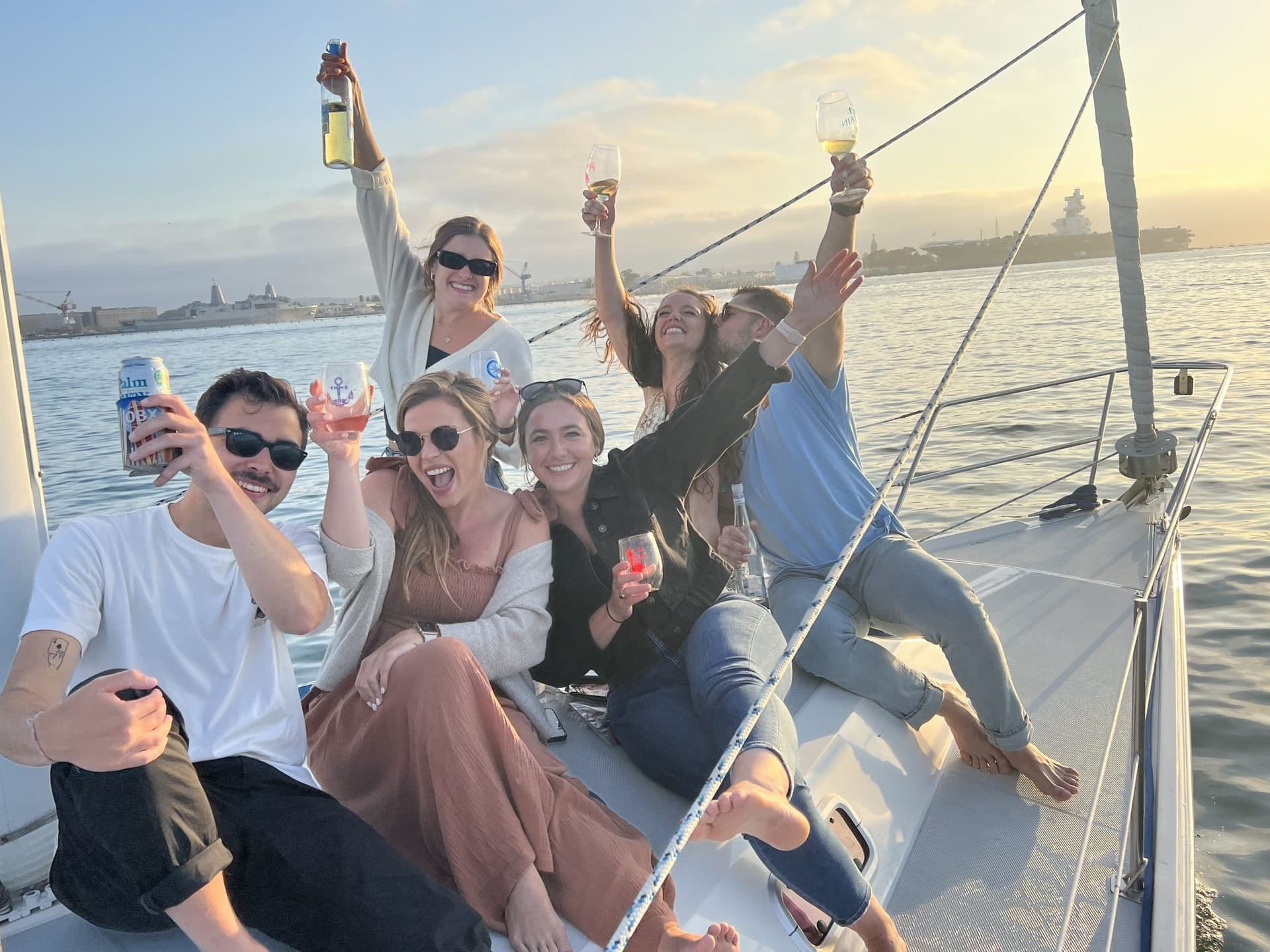
We sail a classic 42-foot yacht, Mojave, on San Diego Bay, and we have watched a lot of sunburns begin as a toast. Everyone is laughing, the downtown towers glow amber, and nobody notices the back of a neck turning pink. This guide is what Captain Liz tells guests before they board.
TL;DR
- Choose broad-spectrum, water-resistant SPF 40 to 50 in a lotion or stick. FDA guidance calls for SPF 15 or higher as a floor, and boat days are long, so aim above it.
- No sunscreen is waterproof. Labels say “water resistant” for 40 or 80 minutes, then the protection is gone.
- Apply before boarding, then reapply at least every two hours and after swimming, sweating or toweling off.
- A mineral formula (zinc oxide and/or titanium dioxide only) is the lower-impact choice for wildlife and swim days. A rash guard and a wide-brim hat do even more.
- Skip aerosols on deck. Wind carries the spray into eyes, drinks and food.
Table of Contents
- Why the water makes the sun stronger than it feels
- What to look for on the label
- How much to use, and where people miss
- Reapplying on a moving boat
- Sunscreen, wildlife and San Diego Bay
- Beyond the bottle: the other sun layers
- Perspective: what we tell every guest
- Packing for your charter by occasion
- Plan a sun-smart day on San Diego Bay
- A simple routine you can copy
- FAQ
- Sources
Why the water makes the sun stronger than it feels
On a sailboat the breeze keeps you cool, and that is the trap. You feel comfortable, so you assume you are fine. Meanwhile the sun reaches you from above and again off the surface of the bay.
The FDA advises limiting time in the sun between 10 a.m. and 2 p.m., when the sun’s rays are strongest, and pairing sunscreen with shade and clothing (FDA). A midday charter sits right in that window, so sunscreen is one layer of a plan, not the whole plan.
Our sunset sailings are gentler on the skin, but not skin-proof. The light is lower and softer, yet a 2-hour cruise that leaves the dock in the afternoon still has plenty of exposure before the sun drops behind Point Loma. If you sail with us for sunset, put sunscreen on anyway, and keep a layer ready for when the air cools.
What to look for on the label
Flip the bottle over. The front is marketing. The back, the Drug Facts panel, is where the truth lives.
Broad-spectrum
Only broad-spectrum sunscreens protect against both UVA and UVB rays. The FDA says that broad-spectrum products with an SPF of 15 or higher help reduce the risk of skin cancer and early skin aging when used with other sun protection measures (FDA, Tips to Stay Safe in the Sun). If the label does not say broad-spectrum, put it back.
SPF: a practical number, not a record
For a boat day we suggest SPF 40 to 50. Practical Sailor recommends SPF 40 or greater for boat use, and its testing takeaway is that applying early, often and liberally matters more than the brand (Practical Sailor). The same report notes that an SPF 70 applied thinly or never reapplied can protect less than a lower SPF used properly.
In other words, the most protective sunscreen is the one that is still on your skin.
“Water resistant,” never “waterproof”
This is the mistake people discover too late. In the United States, sunscreen makers cannot claim “waterproof” or “sweatproof.” The FDA explains that no sunscreen is waterproof and that all of them eventually wash off. Water-resistant labels must say whether the protection lasts 40 or 80 minutes while swimming or sweating (FDA).
That is why a bottle marketed to boaters still needs a second coat. Spray, sweat, a swim and a beach towel all shorten the window.
Lotion or stick, not spray
We steer guests away from aerosols on deck. Wind pushes the mist toward faces, glasses, snacks and the yacht itself, and it is easy to miss patches. A lotion or stick applied at the dock, or in a sheltered spot, gives you even coverage and keeps the cockpit tidy. A small stick is also handy for a quick touch-up on the nose and ears.
How much to use, and where people miss
Most people apply far too little. The FDA says an average adult or child needs about 1 ounce, roughly a shot glass, to cover the body (FDA). For a group of four on a half-day charter, that means a bottle that is meaningfully lighter at the end than at the start.
The areas the FDA singles out for attention are the nose, ears, neck, hands, feet and lips. On a boat we add a few more:
- The part in your hair. Wind lifts hair and exposes the scalp. A hat solves it.
- The back of the neck and tops of the ears. You face the view, and the sun finds your back.
- Tops of the feet. Barefoot on deck, they get hours of direct sun.
- Hands and knuckles. Especially if you are steering a turn or holding a glass.
- Lips. Use a lip balm with SPF and reapply it often.
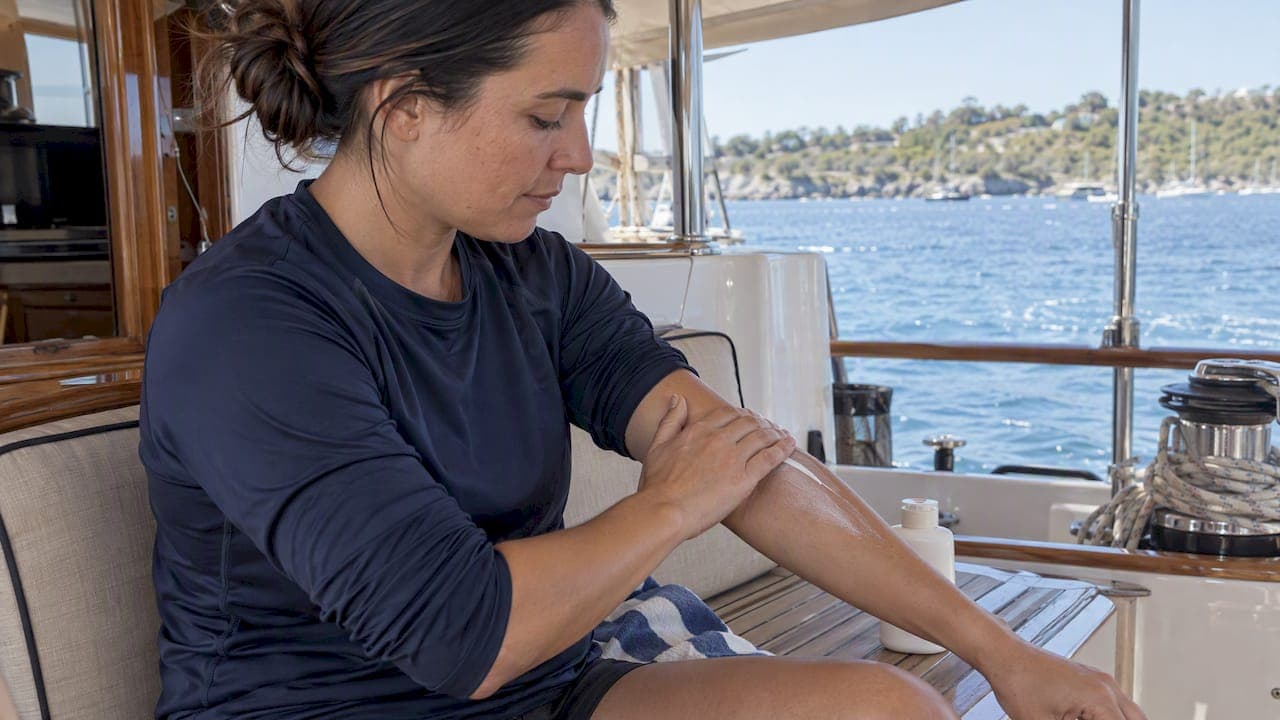
Apply before you board, when your skin is cool and dry. Give it time to settle, because some formulas need about 15 minutes before they work as labeled. Then the first champagne toast, the first sea lion sighting and the first sunset photo do not interrupt your protection.
Reapplying on a moving boat
The two-hour rule is a maximum, not a guarantee. The FDA says to reapply at least every two hours, and more often if you are swimming or sweating (FDA). On a charter, several things trigger an earlier reapplication:
- A swim or a paddleboard session, which is part of our Sail & Swim outings.
- Toweling off, which rubs the product away.
- Sweating on a warm afternoon.
- Heavy spray on a breezy leg across the bay.
We suggest setting a phone alarm for the two-hour mark. A 3-hour or 4-hour charter then includes at least one deliberate touch-up, and nobody has to remember.
Keep the eyes in mind. Do not apply sunscreen right up to the eyelid if sweat or spray could carry it into your eyes. Practical Sailor treats eye exposure as a real boating problem, and the FDA advises rinsing with water if sunscreen gets in. A wide brim and wraparound sunglasses cover that area better than product does.
Sunscreen, wildlife and San Diego Bay
Many of our guests come for the wildlife: sea lions hauled out on buoys, pelicans skimming the water, and in winter the gray whales migrating off Point Loma. If that is your day, it is worth thinking about what washes off your skin.
The National Park Service recommends that swimmers wear a UV-blocking shirt and use sunscreens whose only active ingredients are titanium dioxide or zinc oxide on exposed skin (NPS). Its reef guidance flags oxybenzone, octinoxate and avobenzone as ingredients of concern (NPS).
We want to be honest here. San Diego Bay is not a coral reef, and the science is not settled. The EPA describes UV filters as an emerging contaminant of possible concern, found in water, sediment and animals, and says the ecological effects are not fully understood (EPA). So we will not tell you any product is harmless to marine life. We will say that a mineral-only formula is a lower-impact choice, and that clothing is better still.
Two practical points:
- Ignore “reef-safe” on the front. It is a marketing phrase. Read the active ingredients on the back instead.
- Wear more, spread less. The EPA suggests long sleeves or a rash guard to cut down on the amount of sunscreen you use (EPA). A shirt does not wash off in a swim, and it does not run into the bay.
If you want to learn more about what you might see from the deck, our post on why private charters are a wildlife lover’s dream covers it.
Beyond the bottle: the other sun layers
Sunscreen works best as part of a kit. Here is what we suggest for a San Diego charter:
| Item | Why it earns a place in the bag |
|---|---|
| Broad-spectrum, water-resistant SPF 40 to 50 lotion | Your main protection, applied before boarding |
| Mineral face stick | Quick touch-ups on nose, ears and cheeks |
| SPF lip balm | Lips burn quickly and are easy to forget |
| Wide-brim hat with a chin strap | Shades the face, ears and neck, and survives a gust |
| Wraparound sunglasses | Cut glare and keep spray out of your eyes |
| UPF shirt or rash guard | Protects all day and does not wash off |
| Light long sleeves or a wrap | Useful for sun, and for the cooler air after sunset |
The FDA’s own advice is to combine sunscreen with hats, sunglasses, long sleeves and shade rather than relying on lotion alone. If you want a second opinion on building a budget sun-protection kit for the water, this boating sun-protection checklist walks through three layers worth packing.
Perspective: what we tell every guest
We have hosted couples celebrating anniversaries, families sailing together for the first time, and bachelorette groups with a speaker and a sash. The sunburns we see are almost never about the wrong brand. They happen because people put sunscreen on once, at a hotel, three hours before boarding.
Here is our approach. Mojave carries up to six guests, and every charter is fully private, so there is no rush and no crowd. That gives you room to do this properly. We encourage guests to apply at the dock, tell Captain Liz if they plan to swim, and reapply during the first lull. A good captain plans the day around the weather, and we plan it around comfortable guests too.

We also think it is worth choosing the sunscreen you enjoy wearing. Practical Sailor’s conclusion is that a formula you will apply thickly and often beats a theoretically better one that feels greasy or chalky. For a romantic sunset, that might be a light lotion. For a family with kids, it might be a stick that goes on in seconds.
And please, wear the hat. It is the most underrated piece of equipment on any boat.
— Captain Liz
Packing for your charter by occasion
Couples and proposals
If you are planning an engagement, remember that photos matter. A heavy white cast from a mineral stick on a nose does not photograph well, so apply earlier, blend it in, and try a tinted formula. Test it at home. Our That Someone Special charter is built around the moment, and a sunburned fiancé is not part of the plan.
Families
Children need the same rules with a shorter patience span. Apply before boarding, bring a hat for each child, and keep a stick within reach for quick reapplication. Children under six months should be kept out of direct sun, and a baby’s sunscreen question belongs with your pediatrician. Our family charters are private, so you can pace the day around nap time and snack time.
Bachelorette parties and celebrations
A celebration with champagne, music and karaoke is a good time. It is also a time when people forget everything else. Appoint one friend as the sunscreen captain, set the two-hour alarm, and pack extra sunscreen for the whole group. Drinking in the sun adds to the fatigue, so bring water too.
Wildlife days
Bring binoculars, a hat, and a rash guard or long-sleeve UPF shirt. Staying still on deck watching for dolphins and sea lions means long, steady exposure, so reapply on schedule. When you are looking down at the water, the sun can catch the back of your neck.

Sail & Swim days
If you plan to paddleboard or swim, wear a rash guard in the water and reapply after you dry off. Water-resistant labels cover 40 or 80 minutes of swimming, not an afternoon of it.
Plan a sun-smart day on San Diego Bay
If you want a day on the water with no crowds, no schedule pressure and a USCG-certified captain at the helm, we would love to host you. Our private charters on Mojave include complimentary champagne and drinks, and they are customized to your plan.
- A 2-Hour Sunset Cruise starts from $600.
- Our wildlife charters, including the 2-Hour Bay Wildlife Cruise at $600 and the 3-Hour Point Loma Expedition at $800, are on the wildlife sailing page.
- Sail & Swim starts from $900, and Sail & Swim + Grill from $1,100, with all options on our sailing adventures page.
Tell Captain Liz your plan, including any sun concerns, and we will build the route and timing around it. You can start on our home page.
A simple routine you can copy
If you remember nothing else, remember this sequence:
- The night before, check that your sunscreen is in date and that you have enough, roughly an ounce per person per application.
- At the dock, apply to every exposed area, including ears, neck, feet and lips.
- Put on a hat and sunglasses, and a rash guard if you are swimming.
- Set an alarm for two hours after you started.
- After any swim, towel-off or heavy sweat, reapply right away.
- At home, moisturize. If skin is red, painful or blistered, see a doctor or pharmacist.
FAQ
What SPF is best for a day of boating?
Choose a broad-spectrum, water-resistant sunscreen of SPF 40 to 50. The FDA sets SPF 15 as the minimum for broad-spectrum protection, and Practical Sailor recommends SPF 40 or higher for boat use. Applying enough product, and reapplying, matters more than chasing a higher number.
Is there such a thing as waterproof sunscreen?
No. The FDA does not allow “waterproof” claims on sunscreen in the United States, because all sunscreens wash off eventually. Look for “water resistant” with either 40 or 80 minutes on the label, and reapply after swimming, sweating or toweling off.
What sunscreen is safest for marine life?
The National Park Service recommends mineral sunscreens with only zinc oxide and/or titanium dioxide as active ingredients. The EPA says the full environmental effects of UV filters are still being studied, so no product can be called harmless. Rash guards, hats and shade reduce how much sunscreen you need.
Why avoid spray sunscreen on a boat?
Wind carries aerosol spray into eyes, onto food and drinks, and across deck surfaces, and it is easy to leave bare patches. A lotion or stick applied at the dock or in a sheltered spot gives you more even coverage. It also keeps the boat cleaner.
Do I need sunscreen on a sunset cruise?
Yes, if the cruise starts while the sun is still well above the horizon. The light softens near sunset, but the exposure before that can still burn, particularly on the face and neck. Apply before boarding, and bring a layer for the cooler air once the sun is down.
Sources
- Sunscreen: How to Help Protect Your Skin from the Sun, FDA
- Tips to Stay Safe in the Sun: From Sunscreen to Sunglasses, FDA
- What’s the Best Sunscreen? Practical Sailor
- Sunscreen, Oceans, Coasts & Seashores, National Park Service
- Reef-Friendly Sun Protection, National Park Service
- UV Filters in Sunscreens and Aquatic Environmental Health, US EPA
- What You Can Do to Help Protect Coral Reefs, US EPA